Association for Operational, Open Cloud Infrastructures e.V.
From Europe. For Europe.
The history behind ALASCA
2020
Yaook is initiated by Cloud&Heat Technologies and STACKIT
Open Source transformation followed quickly
2021
Growth of Yaook’s community
2022
Founding of ALASCA in September 2022 in Dresden, Germany
2023 – today
Internal development of ALASCA and its governance
Marketing & events
Today
22 members
(17 companies, 1 association)
7 Open-Source projects
Solid governance including a Technical Steering Committee
ALASCAs goals
Development of open source technologies & promotion of their use
Contribution to public & professional education
Creation of an open & inclusive community
ALASCAs members today (03/2026)
Founders






2023


2024





2025



2026


The stack at a glance
ALASCA cosmos






Political campaigning
- Round tables
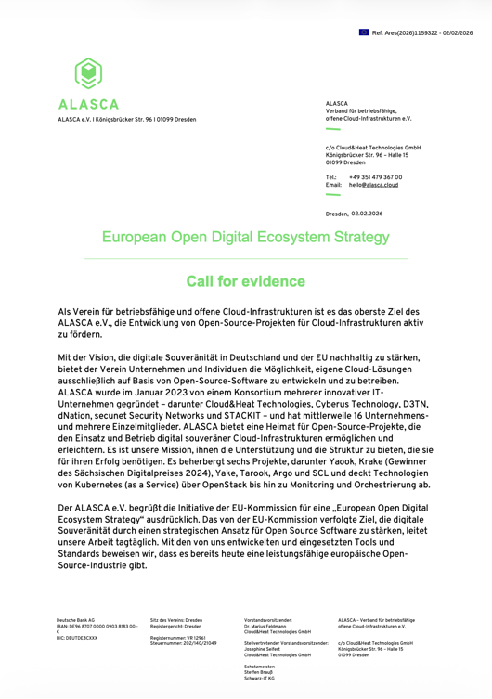
- Responses to the Commission’s calls for evidence — here on the European Open Digital Ecosystem Strategy
-
What we said:
the barrier is demand, not software
- Public buyers still default to proprietary, so nothing rewards investing in open source. We asked the Commission to be the anchor customer and buy open source only, to put “open source by default” into the procurement reform, to set a dated target — European open-source cloud infrastructure from 2030 — and to fund the community work grants never cover: governance, documentation, reviews.
Cloud and AI Development Act
- Timing: tabled June 2026, nothing fixed, years before it binds.
- Complexity: stacked on the AI, Data, Cyber Resilience and Cybersecurity Acts.
- No measure of success: an ambition, not an indicator for OSS success.
- Hardware: only under 10% of the world’s chips are made in Europe and the other 90% are also very expensive. Hard to get by as a SME.
- Open source is the lever: the layer Europe can own today.
- Asymmetric influence: outspent by the firms it should counterbalance. (€151m in 2025)
The open-source chapter excludes ALASCA
-
Article 41, “open source first”:
only requires measures to “encourage” use, subject to
security, total cost and other “duly justified” criteria.
There is no procurement preference.
- Recommendation: make it a preference, not encouragement. We back the initiative itself — see Open Source First and the Architecture of European Sovereignty.
-
EU OSS Catalogue, Article 43: covers software
released by Union entities and public sector bodies. ALASCA is neither.
- Recommendation: turn the Catalogue into a one-stop-shop of pre-integrated, supported stacks, so a buyer acquires a sovereign environment with the convenience of a proprietary cloud. OSS Directory and openCode already do similar things — build on them, do not duplicate them.
-
Article 4(2)(d): “foster the creation of
open-source software foundations” could mean EU money for new
foundations rather than established ones.
- Recommendation: widen it beyond “creation” to sustaining the foundations that already exist — strengthen ALASCA, SCS & NeoNephos and others rather than fund alternatives to them.
“Union added value” misreads open source
-
Article 32(3): rewards software
“designed or manufactured in the Union” and technology
“developed in the Union” — and only in
“innovative” cloud and AI procurements.
- Concern: ALASCA’s projects are European-led, but the stacks they manage — OpenStack, Kubernetes, Ceph — are built by global communities with non-EU governance, and the proposal does neither say how origin is measured for them nor what „innovative” means.
-
Article 32(2)(d): makes non-price award
criteria ancillary and not decisive in the award of the contract.
- Recommendation: the provision risks making all non-price criteria irrelevant and should be deleted.
Openness is audited, not rewarded
-
Annex II criterion J, Annex III §10:
providers using open source must run a risk process for “weak
ecosystem and community support” and apply upstream updates
“without undue delay”.
- Concern: ALASCA already does this, and it is unfair if it applies to open-source vendors alone — all software relies heavily on open source, whether or not its vendor says so.
-
Decisive only at level 4: a fully open,
self-operable stack counts there and nowhere else — and level 4 is
reserved for the narrowest public-order-critical use-cases.
- Concern: everywhere else, being open is compliance overhead without a procurement edge.
Public Procurement Act
-
The barrier is demand: public administrations
still default to proprietary, so nothing rewards sustained investment in
the development and security of open source — which is what holds
back its spread and its long-term maintenance.
- Recommendation: if the Commission wants a robust, diverse and competitive European open-source ecosystem, it must take up its role as anchor customer consistently.
-
Award criteria: contracts are decided on
price, which says nothing about who maintains the software underneath.
- Recommendation: move beyond price and weigh a vendor’s expertise, reliability and contribution — past and present — to the health of the underlying open-source projects, so that buying also sustains the supply chain.
Thank you. Stay in touch.
Web
- Website alasca.cloud
- Docs docs.alasca.cloud
- Summit 2026 alasca.cloud/alasca-summit-2026
- Tech-Talks alasca.cloud/alasca-tech-talks
- Podcast alasca.cloud/alasca-opensnac-der-podcast
- GitLab gitlab.com/alasca.cloud
Community
- Mastodon mastodon.social/@alasca
- LinkedIn linkedin.com/company/alasca-cloud
- Mailing lists lists.alasca.cloud
- Matrix #ALASCA:matrix.org
- YouTube youtube.com/@alasca_e.V.